
1.0 Introduction: Beyond Telling to Selling
In today’s competitive business environment, the ability to communicate effectively is not merely a soft skill—it is a strategic imperative. Standard presentations that simply convey information are no longer sufficient to capture attention, persuade stakeholders, or drive meaningful action. This guide is designed to equip you with a powerful methodology known as ‘story-selling,’ a framework that transforms routine business communications into compelling narratives that influence decisions and achieve critical objectives.
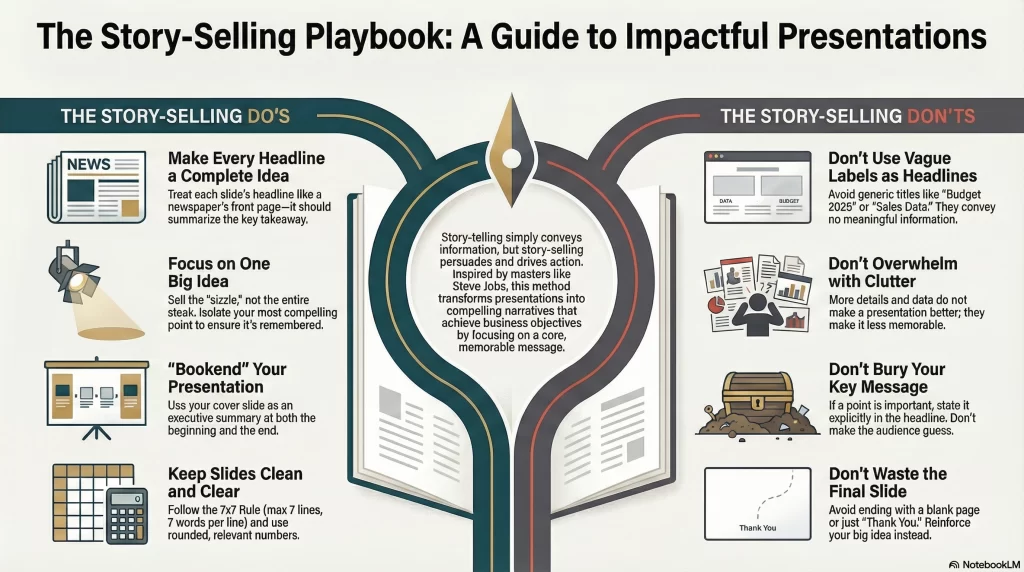
The core distinction lies in the intent and impact of your message. Story telling is the act of conveying ordinary information. Story selling, on the other hand, is the craft of building a compelling narrative that sells an idea, a vision, or a call to action. In the world of business, this can be the difference of “billions of dollars.” The guiding maxim is simple yet profound: “Stories Tell. Compelling Stories Sell.” The late Steve Jobs was a maestro of this discipline. He didn’t just tell stories about Apple’s products; he sold them, masterfully editing out any details that did not serve his ultimate goal, “even on occassions when he had nothing finalized.”
The ultimate outcome of mastering story-selling is to “get what you want.” This applies to every facet of life, from personal milestones like getting married to professional achievements like being hired for a dream job. In any competitive scenario, the individual who sells the better, more compelling story is the one who wins.
The following sections provide your blueprint for execution, moving from the unshakeable foundation of your presentation’s structure to the persuasive details of its content and delivery.
2.0 The Blueprint: Structuring Your Presentation for Maximum Impact
A compelling story is not a stream of consciousness; it is an engineered experience. To command your audience’s attention, you must guide them through a deliberately engineered structure. Professor Bong De Ungria’s “bookend” framework is a powerful psychological tool that primes your audience, guides them through your narrative, and reinforces your core message to ensure it sticks.
The “Bookend” Principle
- The Cover Page: Your First Impression and Executive Summary. Your first slide is your most valuable real estate. It must function as the presentation’s executive summary, immediately communicating the core purpose and value proposition. A high-impact cover page must include:
- A creative Main Title that sets the theme (e.g., “Convince like Steve”).
- A clear Secondary Title that provides essential context (e.g., “to sell your business story”).
- The Presenter’s Name to establish authority.
- A Visually Appealing Design that uses a deliberate combination of text color, images, and fonts to create a professional and engaging first impression.
- Consistent Format Elements, such as brand logos, color bands, or links, to maintain a polished and consistent look throughout the presentation.
- The Outline Page: Your Narrative Roadmap. The second slide’s role is to “introduce what you will say.” This is your narrative roadmap, and it must be descriptive and specific. Avoid generic outlines using terms like “Introduction,” “Body,” and “Conclusion,” as they add no value. Remember the principle: be specific to be terrific. An effective outline provides a clear preview of the journey ahead (e.g., “Why use power presentations,” followed by “Techniques of presentation”). This primes the audience and makes your story easier to follow.
- The Summary Page: Reinforcing the Key Takeaways. The second-to-last slide must be a summary that “repeats what you just said,” reinforcing the most critical points. Crucially, this slide should be similar to, but not the same as, the outline page. The content must be reworded to reflect that the concepts have now been fully explained. For example, instead of an outline point that says “local application,” the summary point should specify what that application was, demonstrating that the narrative has progressed.
- The End Page: The Final, Powerful Echo. The final slide is the closing bookend, serving as the last opportunity to reinforce your big idea. It can be the same as the cover page or a slight variation of it. Never end with a blank page or a generic “Thank You” slide. This wastes the final, critical moment to leave your core message imprinted on the audience’s mind.
With this solid structural framework in place, we can now turn our attention to crafting the persuasive content that will reside within it.
3.0 Crafting the Content: Principles of Persuasive Slide Design
Beyond the macro-structure, strategic execution at the slide level is paramount. Effective slide design is not about aesthetics alone; it is a discipline rooted in psychological impact and the pursuit of absolute clarity. The reason the “Bookend” structure is so critical is that it is engineered to combat the powerful mental filters every audience member uses. Every slide you create must serve this same strategic purpose.
Focus on the Big Idea
The human mind is not a recording device. Your audience is subject to a series of psychological filters that dramatically reduce the amount of information they actually process and remember:
- Selective Attention: They only hear and see a fraction of what you present.
- Selective Distortion: They unconsciously filter and interpret your message through the lens of their own biases and personal context.
- Selective Retention: They ultimately remember only a small portion of what they distorted.
You cannot win a war on all fronts. Therefore, your strategy must be one of overwhelming force on a single point. You must “sell the sizzle, not the steak.” This isn’t about deception; it’s about strategic focus. Ruthlessly select the single most powerful, resonant part of your truth, magnify it, and build your entire narrative around it. This is how you ensure your “big idea” is the one thing that survives the audience’s mental filters.
Executing the Perfect Slide
- Headlines over Labels: Every slide must have a headline that is a complete, powerful idea, not a generic title. A poor label like “Budget for 2020” says nothing. A powerful headline like “Invest 12 million in our proposed CRM” makes a clear point and states an objective. The headline’s primary task is to pull the reader into the slide’s details and frame their interpretation of the data that follows.
- The 7×7 Principle: Adhere to a strict rule: a maximum of 7 lines of text per slide, and a maximum of 7 words per line. This principle is not arbitrary; it forces you to eliminate clutter, distill your thoughts, and place the emphasis squarely on your most important ideas.
- The Law of Relevant Numbers: Use numbers that are meaningful, contextual, and easy to remember. An exact figure like “24,102,304.39” is noise; “24 million” is a clear signal. However, do not oversimplify to the point of hiding the truth. For instance, stating a metric is “2%” could be misleading if the actual figure is 2.4%, a meaningful difference. Find the right balance to make your data impactful, not overwhelming.
- Visual Hierarchy: Guide your audience’s eyes. Use font size, color (such as red for headlines), capitalization, and bolding to signal the relative importance of every element on your slide. As seen on magazine covers, the most important word should be the largest, boldest, and most prominent, creating an instant understanding of what matters most.
- The Sync & Build Effect: Build your slides one idea at a time to control your audience’s selective attention in real time. Text and relevant images should appear on screen precisely as you discuss them. This prevents the audience from reading ahead and ensures they are synchronized with your narrative. The simplest and most reliable way to achieve this is to duplicate a slide and add one new element at a time. This creates a clean, professional build effect and is far easier to manage than relying on complex software animation functions.
Having crafted clear and persuasive content, the final step is to bring it to life through a dynamic and memorable delivery.
4.0 Delivering the Narrative: Emulating the Maestro’s Performance
Even a perfectly structured and brilliantly designed presentation can fail if the delivery lacks energy, conviction, and a touch of theater. This is the final, crucial step that makes the “big idea”—so carefully structured and designed in the previous sections—truly unforgettable. Steve Jobs was the ultimate example of a presenter who understood this. He treated his keynotes not as mere announcements, but as a “show” or a major “event” designed to inspire his audience by perfectly executing the principle of “selling the sizzle.”
Here are advanced delivery techniques, derived from the maestro himself, to elevate your performance:
- Demonstrate Palpable Enthusiasm: Your passion is contagious. A presenter must show genuine excitement for their topic. Steve Jobs frequently used powerful, positive words like “extraordinary,” “amazing,” and “cool” to convey his belief in his products. This aligns with the principle that a voice-over must have “energy and excitement, not boring.” If you are not passionate about your idea, your audience never will be.
- Make Numbers Meaningful: Data alone is dry and forgettable. To make numbers resonate, you must place them in a relatable context. Instead of just stating, “we have sold 4 million iPhones to date,” Jobs added the context that made it powerful: “…that’s 20,000 iPhones every day on average.” This simple calculation transforms an abstract number into a tangible and impressive achievement.
- Sell an Experience, Not a Product: Shift your focus from conveying information to inspiring your audience. Steve Jobs wasn’t just selling hardware; he was selling the experience of using that hardware to change your life. Frame your presentation around the benefit, the feeling, and the transformation your idea offers.
- Create a “Wow” Moment: Every great performance has a memorable peak. Engineer a moment of dramatic flair that will stick in your audience’s memory. The iconic example is Jobs pulling the ultra-thin MacBook Air from a standard manila inter-office envelope—a simple, visual, and unforgettable demonstration that instantly communicated the product’s core innovation.
- Rehearse, Rehearse, Rehearse: An effortless-looking presentation is the direct result of hours of dedicated practice. Complex presentations that involve live demonstrations, video clips, and multiple speakers cannot be executed flawlessly without extensive rehearsal. Practice until your delivery is so smooth and synchronized that it appears completely natural.
- Master the “And One More Thing…” Encore: This classic Jobsian technique is a masterful way to heighten drama and build excitement. By saving a key announcement for the very end, after the audience believes the presentation is over, you create the feeling of an exclusive bonus. It is a powerful method for leaving the audience on a high note and creating a strong, lasting final impression.
To ensure these principles are embedded in your workflow, the final section provides a consolidated checklist for your review.
5.0 The Definitive Checklist: Story-Selling Do’s and Don’ts
This final section distills all the preceding principles—from strategic structure to masterful delivery—into a single, actionable checklist. Use this as a final review tool to audit and refine your presentation, ensuring every element is optimized to persuade, influence, and achieve your objective.
Story-Selling Best Practices
| MUST DO | MUST NOT DO |
| Structure: Use the “bookend” format with a Cover Page as the Executive Summary and a matching End Page. | Structure: End with a blank slide or a simple “Thank You.” |
| Outline: Use a descriptive outline that gives a specific overview of what is to come. | Outline: Use a generic outline with terms like “Introduction,” “Body,” and “Conclusion.” |
| Headlines: Write a complete, powerful idea as the headline for every slide. | Headlines: Use a simple title or label (e.g., “Sales Data”) as the headline. |
| Content: Follow the 7×7 principle (max 7 lines, 7 words per line). | Content: Overwhelm the slide with text, long paragraphs, and clutter. |
| Numbers: Use relevant, rounded numbers to make them meaningful and memorable (e.g., “7 million”). | Numbers: Present exact, lengthy numbers that are hard to read and recall (e.g., “7,023,985.30”). |
| Visuals: Use appropriate, labeled images that appear in sync with the narration to aid memory. | Visuals: Allow text and visuals to overlap, interfering with clear communication. |
| Design: Use font size, color, and capitalization to create a clear visual hierarchy of importance. | Design: Use font sizes that are too big or too small for the overall slide. |
| Delivery: Narrate with energy, excitement, and passion. | Delivery: Speak in a monotonous tone. |
| Focus: Focus on one “big idea” per slide. Use multiple simple slides instead of one complex slide. | Focus: Put too many ideas on a single, cluttered slide. |
| Rehearsal: Rehearse extensively to ensure a smooth, synchronized, and effortless-looking delivery. | Rehearsal: Rely on holding a notebook, cue card, or phone for notes during the presentation. |
Ultimately, story-selling is a deliberate skill, not an innate talent. It is a craft that can be learned, practiced, and perfected. By internalizing and applying the principles in this playbook, any professional can move beyond simply presenting information and begin crafting compelling narratives that captivate and persuade. You can transform your communication, influence your audience, and consistently achieve your most important outcomes.
Relevant info:
Or check out this blogpost