
Dear Blue Eagle,
You’re reading this because you’re nervous, curious, excited, stressed or all of the above. Maybe it’s the night before your oral defense, or perhaps you’re staring at the start of your strategic management paper wondering how you’ll ever get through this. I get it. After sitting on defense panels since 1997, I’ve seen that same look of uncertainty cross the faces of hundreds of professionals just like you—capable leaders who’ve led teams, closed deals, transformed businesses, yet suddenly feel like freshman students again.
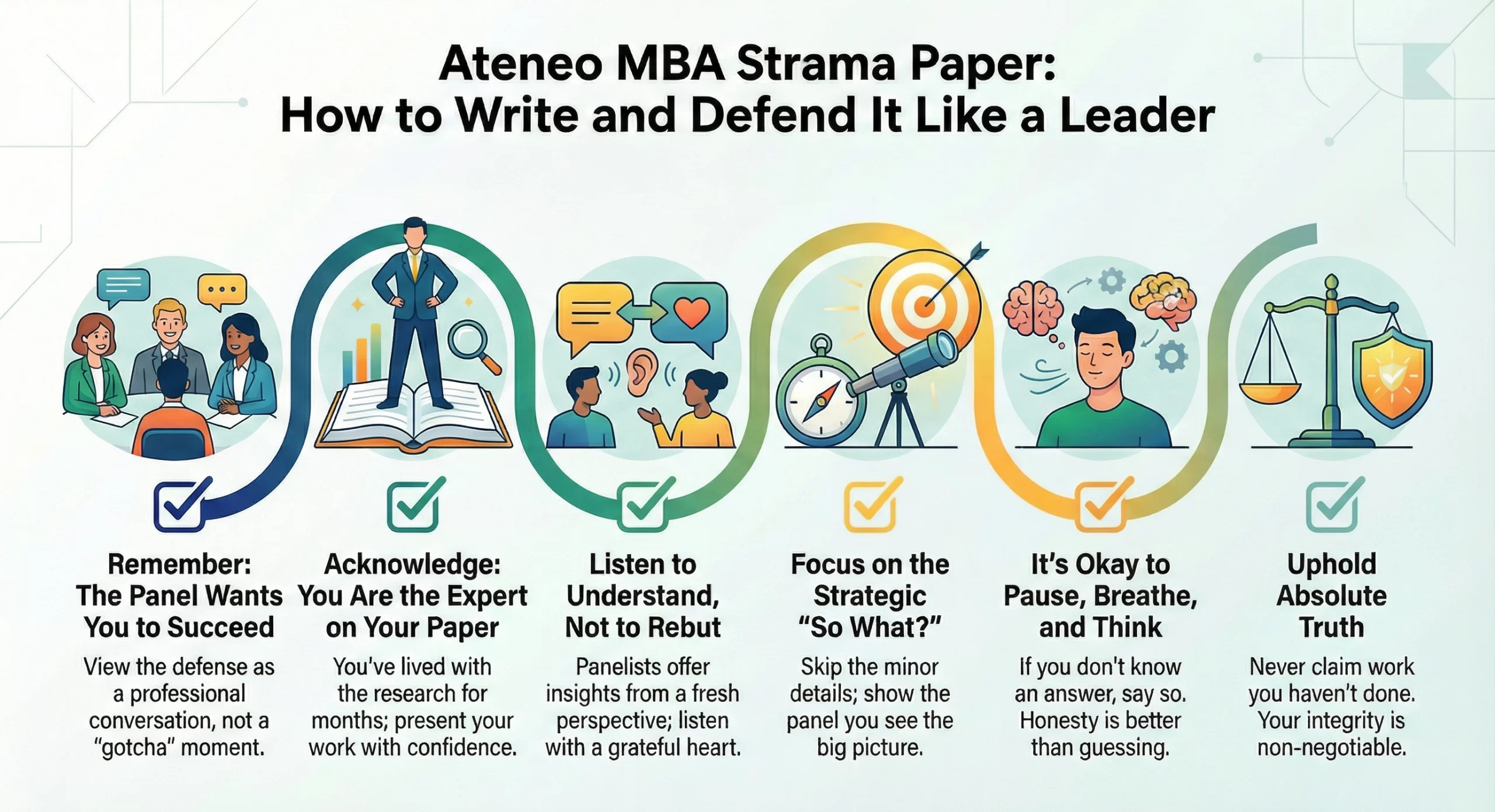
Here are empowering context that may make this what you need and want it to be.
Watch the video on Youtube and/or read the post below:
You’ve Already Proven Something Important
Congratulations. Not the polite kind. The real kind.
You made it this far while juggling a career, possibly a family, definitely a mortgage, and all the chaos that comes with being 28 to 45 in today’s world. You didn’t just survive—you showed up. Week after week. Paper after paper. That counts for more than you think.
Whatever happened before this moment? It’s done. But what happens next? That’s entirely yours to shape.
Let Me Tell You What You’re Actually Walking Into
The unknown is terrifying. So let’s make it known.
Here’s the truth most students don’t realize: You are walking into a room of people who want you to succeed. Not in a participation-trophy way. In a real, professional way. These panelists—professors who’ve built careers, practitioners who’ve lived your industry struggles—they’re investing their time because they believe you have something worth examining.
Your defense isn’t a gotcha moment. It’s a conversation between professionals.
Listen Like Your Success Depends On It (Because It Does)
When your panelists speak, here’s what NOT to do: mentally rehearse your rebuttal while they’re still talking.
Here’s what to do instead: Listen with a grateful heart.
I know how that sounds. You’re thinking, “Prof, I’m trying to survive here, not achieve enlightenment.” But stay with me.
These panelists are reading your 200-page paper in between their own deadlines, their own chaos. When they challenge you, they’re not attacking—they’re pointing at blind spots you couldn’t see because you’ve been too close to the work for too long.
Clear your mind. Really listen. They’re trying to hand you insights you didn’t know you needed.
Remember Who the Expert Is (Hint: It’s You)
Here’s something that might surprise you: You know more about your paper than they do.
You’ve lived with your research question for months. You’ve dug through data, interviewed stakeholders, lost sleep over methodology. Unless your panelist happens to work in your specific industry with your specific company, you are the subject matter expert in that room.
This doesn’t mean you get to be arrogant. It means you get to be confident.
When a panelist offers a perspective that seems off, it’s usually because they missed a nuance buried somewhere in those 200 pages. You don’t have to agree with everything they say. What you do have to do is demonstrate that you understand your own work deeply enough to respectfully explain why your approach makes sense.
Professional disagreement is not disrespect. It’s evidence of expertise.
The Statistics You Need to Hear (And Then Forget)
An overwhelming majority of students pass their defense.
But throw that statistic out the window. It doesn’t apply to you because you’re not a statistic—you’re a specific human being with a specific paper that will be evaluated on its own merits.
What those numbers DO tell you? The panel isn’t there to destroy you. The system isn’t designed for you to fail. This is a rigorous academic process, yes, but it’s one that assumes you’ve done serious work and wants to validate it.
When You Don’t Know the Answer
Pause. Breathe. Think.
If you don’t know something, say so. If a question isn’t clear, ask for clarification. If you need to look something up after the defense, tell them you’ll follow up.
And here’s permission you might not realize you have: If the first words out of your mouth are wrong, you can take them back.
“Actually, let me restate that…” is a perfectly acceptable sentence in an oral defense. Nervousness makes us all say imperfect things. The panelists understand. They’ve been nervous too. They’re human beings who’ve made mistakes in high-pressure situations.
What matters isn’t perfection. It’s honesty and the willingness to think clearly under pressure.
Skip the Weeds, Hit the Heights
You don’t have time to walk through every variable, every data point, every minor finding.
The panel doesn’t need the nitty-gritty. They need the “so what?” They need to understand that you see the forest, not just the trees.
Speak to the strategic level. Show them you can think like the leader you already are in your day job.
This Defense Doesn’t Define You
Let’s be honest about something important.
Whether you pass, fail, or need to rewrite—you will not be the first, and you certainly won’t be the last. This is part of the process you signed up for when you chose the rigor of an Ateneo MBA.
Your paper is not perfect. No paper is. Perfection isn’t expected or required.
The Strategic Management paper is a milestone in your journey, not the destination. The oral defense is a learning experience, not a final judgment on your worth.
Ten years from now, you won’t remember your exact grade. You’ll remember what you learned about yourself under pressure. You’ll remember whether you handled uncertainty with grace. You’ll remember that you showed up even when you were afraid.
The One Non-Negotiable: Truth
Tell the truth as you really know it.
Never -and I mean never- claim something you truly know isn’t true, or you are not sure of.
I once watched a student fail because, out of nervousness, he said he’d conducted a survey when he hadn’t. Then during the rewrite, he fabricated the survey data and got caught. His career was damaged. His reputation suffered. All because fear made him choose a shortcut.
The students who don’t make it through have one or more of these issues:
- They didn’t complete the work
- They didn’t do the work honestly
- They refused to listen to feedback
- They didn’t understand their own numbers
- They weren’t willing to put in additional effort when needed
None of those sound like you. You wouldn’t be reading this if you were that person.
Frame This Experience Through the Values That Brought You Here
You chose Ateneo for a reason. Maybe it was the reputation. Maybe it was the network. Maybe it was something deeper—the Jesuit values that speak to excellence, service, and faith.
Whatever brought you here, let those values carry you through this moment.
Men and women for others. You’re doing this work not just for a grade, but to become a better leader who can serve your organization, your industry, your community.
Magis. The more. The better. Not perfection, but the continual striving toward excellence.
Cura personalis. Care for the whole person. That includes caring for yourself through this stressful process. Be kind to yourself. You’re doing something hard, and that deserves respect.
And when it’s all done—whether you walk out with relief, joy, or even disappointment—remember the motto that binds every Blue Eagle:
Ad Majorem Dei Gloriam.
For the greater glory of God.
This defense, this degree, this entire journey—it’s all part of something larger than grades and transcripts. You’re being shaped into the leader you’re meant to become.
One Last Thing
Years from now, someone younger will ask you what the oral defense was like.
You’ll smile—maybe a little wistfully—and you’ll tell them: “It wasn’t as scary as I thought it would be.”
And then you’ll pass along some version of this wisdom, because that’s what Blue Eagles do. We lift each other up.
So breathe. Trust your preparation. Show up as your authentic, professional self.
Soar, Blue Eagle.
Fly.
ProfIA BONG
Who believes in you, even if you’re not sure you believe in yourself yet
Communicate your story better. More info here: